Commissioned Review

Pastoral: To Die in the Country (1974)

Shūji Terayama may cast his rural childhood in an array of surreal, kaleidoscopic motifs, yet this memory piece does not yield easily to nostalgia or repression, as Pastoral: To Die in the Country contemplates the unstable, self-reflexive act of reminiscence and its sublimation into art.

A Touch of Zen (1971)

As King Hu edges towards a spiritual transcendence in A Touch of Zen, wuxia spectacle dissolves into a meditative, cosmic stillness, revealing its worldly struggles between imperial authorities and persecuted fugitives as fleeting dramas within a transient world.

Woman in the Dunes (1964)

Through Hiroshi Teshigahara’s elemental metaphor in Woman in the Dunes, sand becomes the formless structure of one man’s existential imprisonment, trapping him in a Sisyphean struggle of labour that slowly absorbs him into a primordial, ever-shifting desert.

Marketa Lazarová (1967)

Although the Christianity of medieval Europe encroaches upon a primordial pagan world in Marketa Lazarová, František Vláčil does not grant moral authority to any single religion, but rather dissolves historical certainty into a fragmented, mythic haze.

Cyberpunk: Edgerunners (2022)

Humanity’s cybernetic ambitions are no match for its darkest impulses in Cyberpunk: Edgerunners, as Hiroyuki Imaishi traces one fledgling mercenary’s ascent through Night City’s underworld, and unleashes an assault of neon-lit, hyper-stylised violence.

The Travelling Players (1975)

Against the political turmoil of mid-century Greece in The Travelling Players, Theo Angelopoulos’ theatrical microcosm captures a fragmented nation caught between competing powers, dissolving time through long takes that conjure a swirling, ceaseless nightmare.

Cobra Verde (1987)

Cobra Verde may not be as tightly focused as Werner Herzog’s grander masterpieces, yet in this grotesque nightmare of one bandit’s mission to revive Western Africa’s slave trade, it brutally exposes the barbaric machinery of empires built on the systemic commodification of suffering.

Star Wars: Episode III – Revenge of the Sith (2005)

For all the flaws that plague the Star Wars prequels, very few can detract from the operatic descent into darkness that Revenge of the Sith ushers in, seeing George Lucas embrace the melodrama, myth, and political allegory of his epic saga to craft its most tragic chapter.

Star Wars: Episode II – Attack of the Clones (2002)

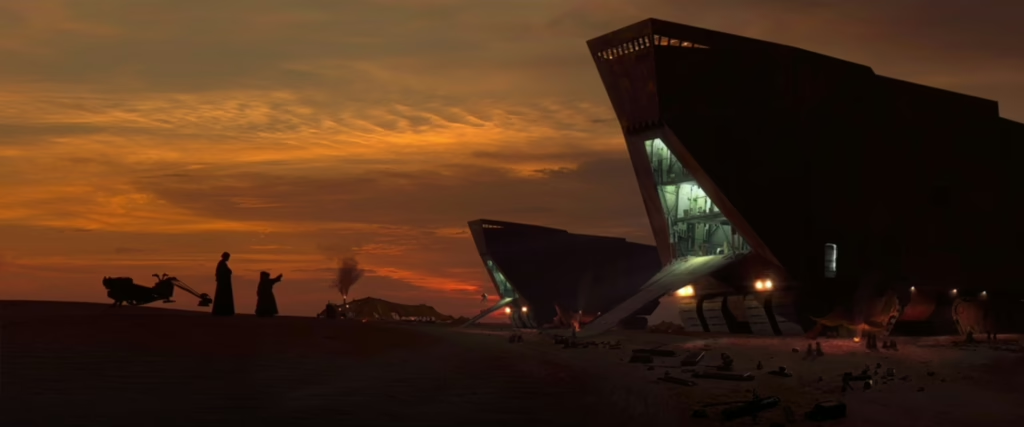
As a grown-up Anakin Skywalker begins to break beneath the weight of duty and desire in Attack of the Clones, George Lucas thoughtfully recaptures the mythic tension of the original Star War trilogy, exposing the corrosive, insidious decay that eats away at the heart of democracy’s heroes, institutions, and ideals.

Star Wars: Episode I – The Phantom Menace (1999)

George Lucas’ myth-making ambitions are undoubtedly bold in The Phantom Menace, serving as a visually and narratively uneven foundation to the darker chapters ahead, yet resolutely daring to ignite the slow-burning fuse of the Star Wars saga’s most tragic, fateful transformation.

Scroll to Top