
Ardak Amirkulov | 2hr 37min
This review was requested by Ravshan. Find out how to commission review of a film of your choice here.

The Fall of Otrar was not intended to be a historical premonition, though unfortunately for Ardak Amirkulov, the empire that had financed his tale of imperial decline would dissolve before the film was completed. Such is the nature of grand civilisations built on nationalist hubris that they inevitably sow the seeds of their own destruction, and in this regard, the ancient city of Otrar and the Soviet Union become unlikely reflections of each other. One of the world’s great superpowers may have collapsed, yet still Amirkulov was intent on seeing the project through, taking out a massive personal loan and ultimately realising one of the most ambitious films in Kazakh cinema.
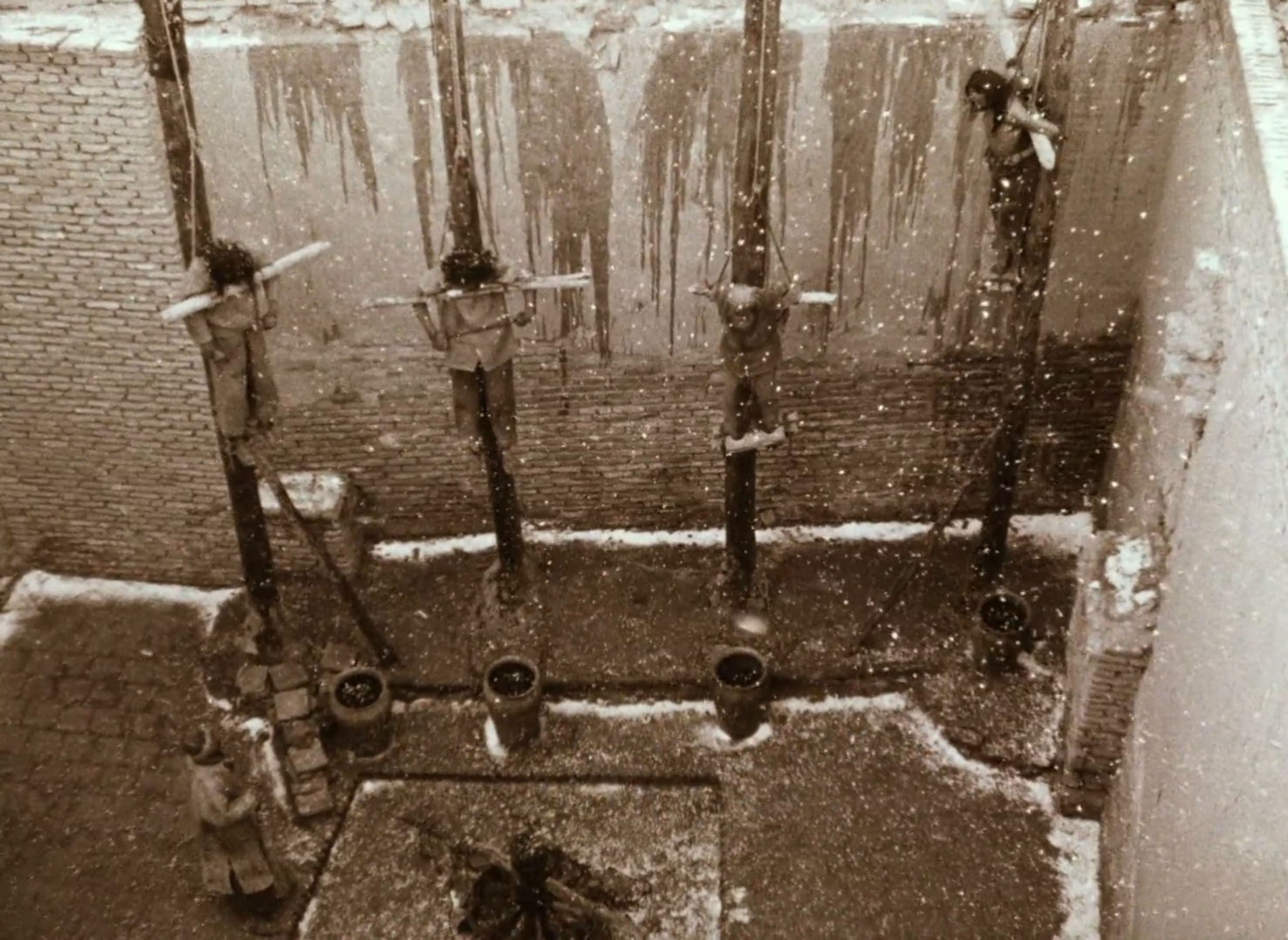
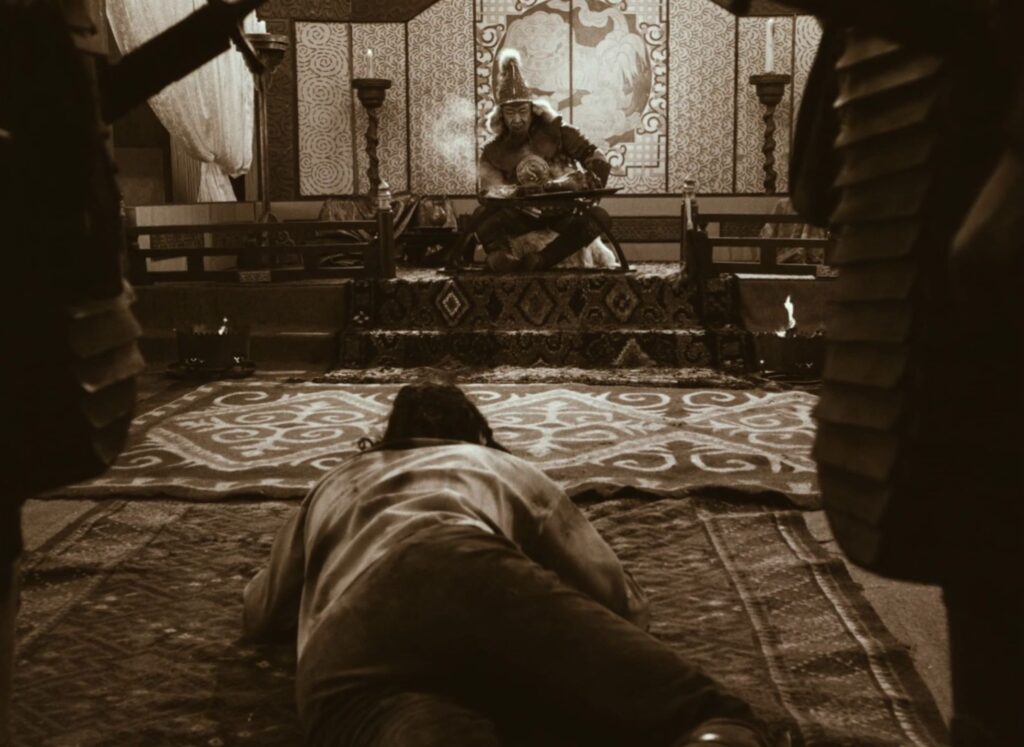
Kipchak scout Unzhu’s aspirations are not nearly as grand as Amirkulov’s, though he certainly shares his creator’s defiance, serving The Fall of Otrar as a stubborn survivor and weary witness to the disintegration of his proud civilisation. He has spent many years spying on Genghis Khan in the East, beholding the might of his Mongol hordes and learning of their plans to conquer Central Asia, though earning the trust of Mukhamed-Shah of Khwarazm may be his most formidable challenge yet. Genghis Khan is of little concern, Mukhamed-Shah decides, and this scout may as well be a traitor spreading lies to weaken the city-state from within. As Unzhu is tied to a wooden beam and left hanging in a muddy courtyard, Mukhamed-Shah instead turns his attention westward, plotting his expansion into Baghdad while remaining blind to the threat gathering in the East.

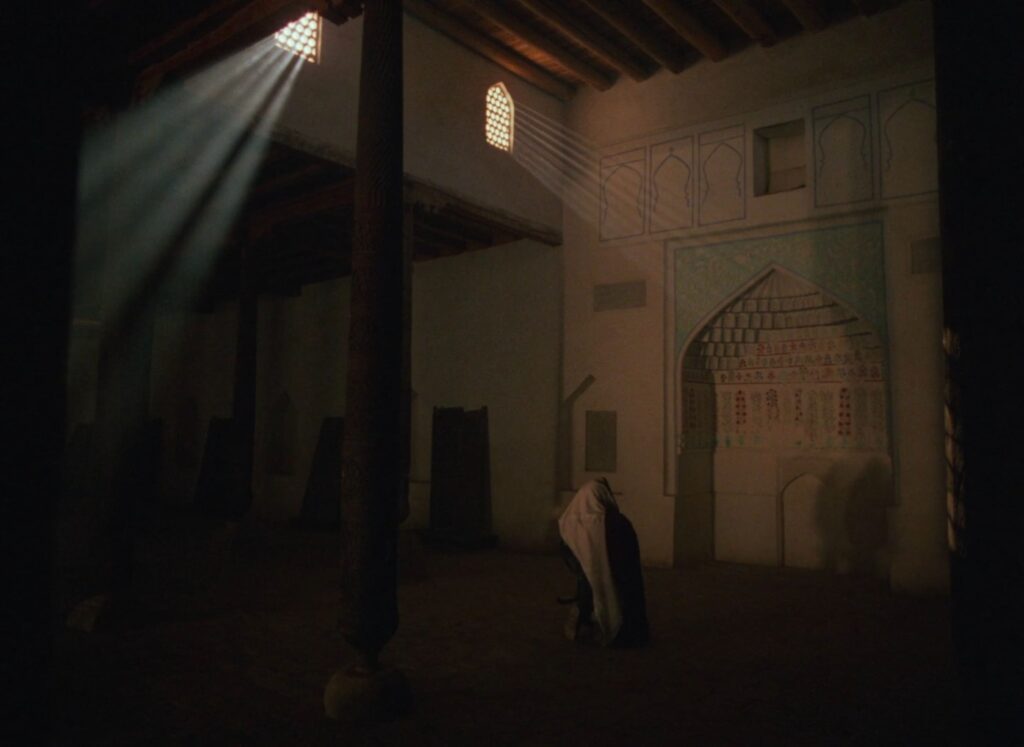
The Soviet Union may have held a tight grip over its film industry, dictating Socialist Realism as the artistic doctrine to which all filmmakers were expected to conform, yet the Kazakh New Wave evidently afforded Amirkulov a certain creative freedom. Earlier Soviet auteurs such as Sergei Eisenstein and Andrei Tarkovsky also wield a considerable influence here, especially given their own engagements with subversive historical epics, respectively critiquing state power and examining spiritual devotion. Just as The Fall of Otrar’s monumental architecture and ceremonial blocking recall Ivan the Terrible, using court spectacle to reinforce its ruler’s ego, so too does it inherit the visual tactility, long takes, and existential weight of Andrei Rublev. Elemental textures consume this medieval world, caking its characters in layers of mud, and Amirkulov’s wide-angle lenses capture such brutal decay in coarse, visceral detail.
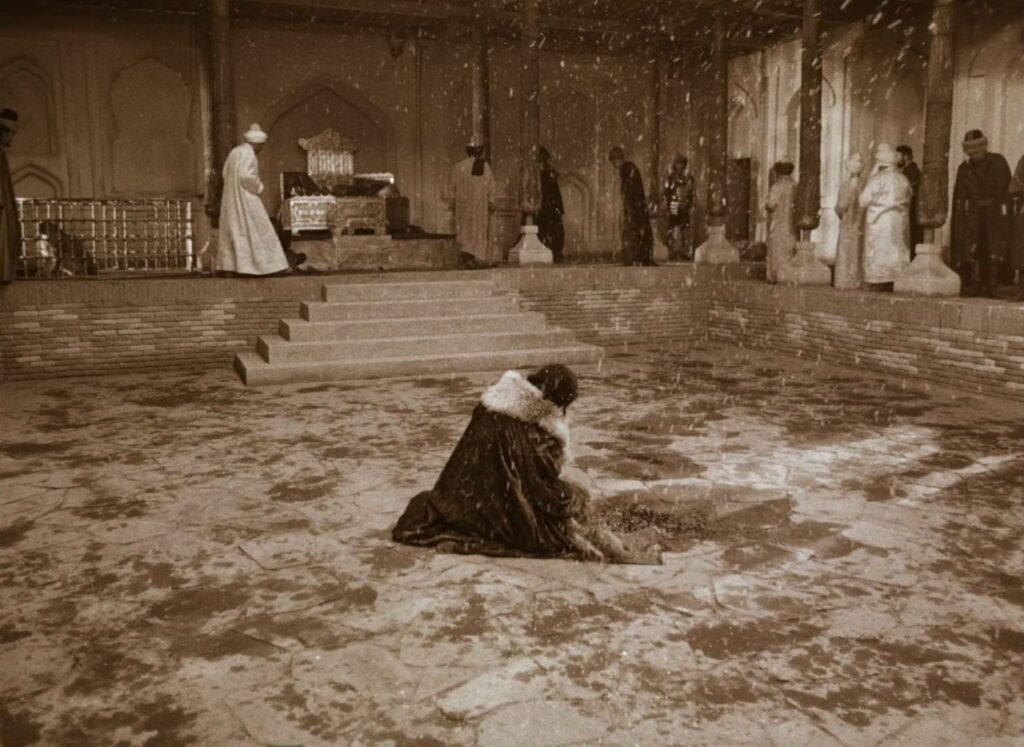
Of course, there is another aesthetic tension woven even deeper into The Fall of Otrar’s historical reconstruction, distinguishing immediate reality from fading, archaic memory. As Kairkhan, governor of Otrar, prays for Mukhamed-Shah to see reason and believe Unzhu’s report, Amirkulov bathes the room’s frescoes and sunrays in full colour, and draws this vivid palette through similar scenes that preserve the illusion of an unwritten destiny. Meanwhile, the sepia monochrome that dominates his film actively undermines this illusion, preserving the story like some ancient artefact dug up from the ruins of a forgotten civilisation. Otrar’s tragic fate tangibly stains these faded frames, and in its weathered reconstruction, imbues them with a sombre beauty that serves as the last testament to the city’s former glory.

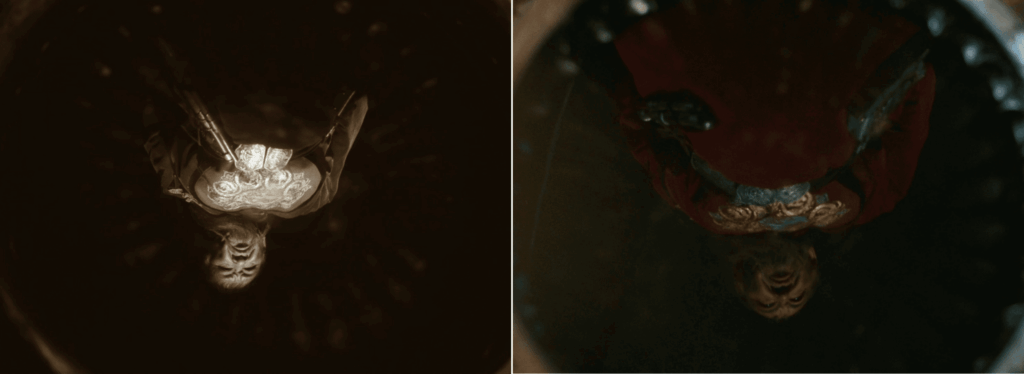
After an hour of soaking in the treachery of Khwarazm’s politics and Unzhu’s relentless torture, Amirkulov finally introduces that mythic warrior whose shadow looms over Otrar, and whose reflection ripples upside down in a trembling pool of water. Although historians have debated the extent to which Genghis Khan’s commercial ventures concealed imperial ambition, Amirkulov’s portrayal of the warlord is as sly as he is merciless, plotting to send his forces to Otrar disguised as merchants. He is fully aware his enemy’s weaknesses, and as his reflection bookends the scene with a shift to colour, this legend of conquest emerges from the sepia pages of history into a terrifying reality.
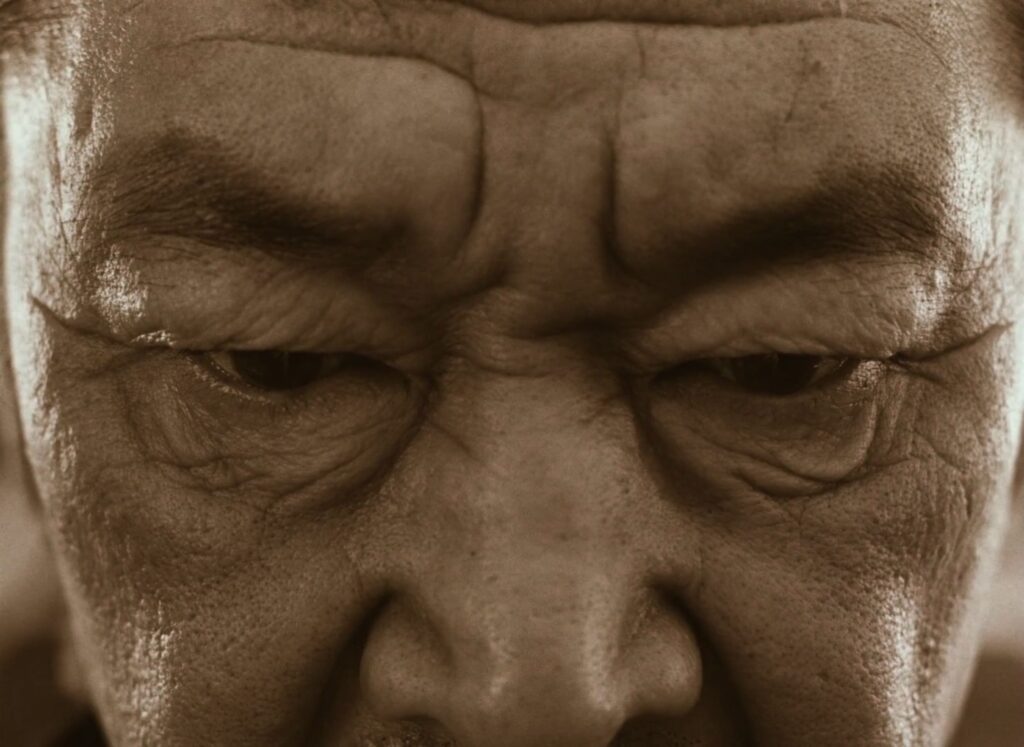
Kairkhan may strike down Genghis Khan’s caravan in one swift blow after suspecting its true purpose, though still Mukhamed-Shah’s reckless hubris prevails when he further executes three of his foe’s envoys. Therein lies the historical catalyst for the Khan’s wrath, acutely concentrated in an extreme close-up that captures every wrinkle etched into his deep, furrowed brow. From there, this vengeful anger reverberates across every corner of Khwarazm, and accelerates Amirkulov’s epic narrative towards inevitable catastrophe.
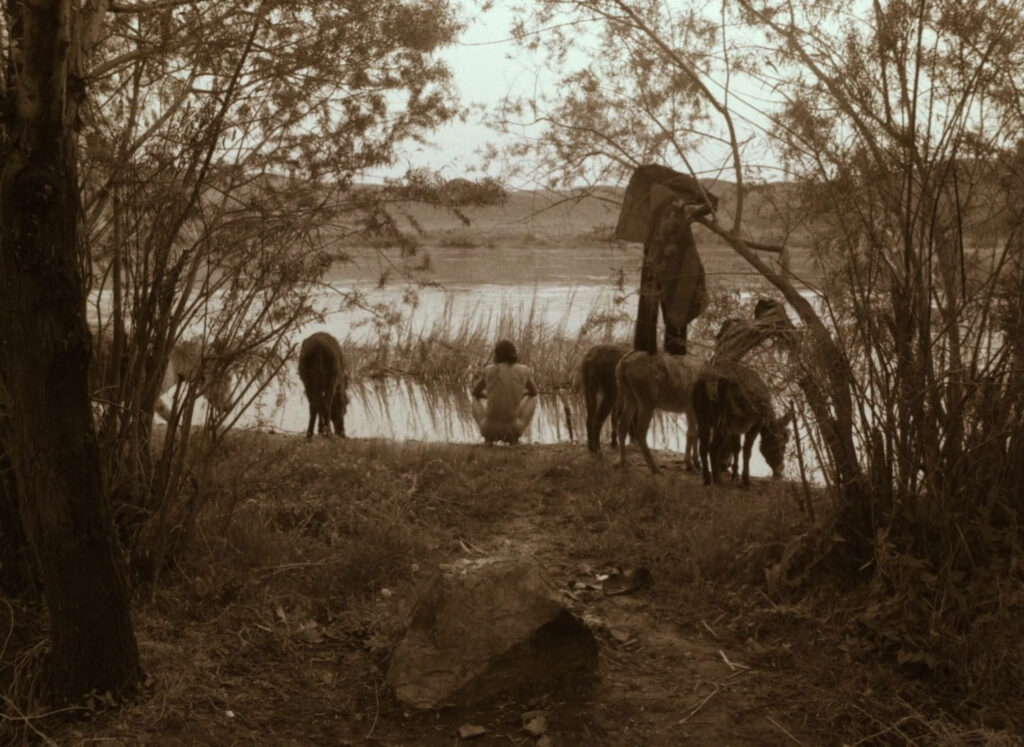
Still, The Fall of Otrar is not so concerned with military spectacle as to overlook the lives crushed beneath it. Released from captivity by the sympathetic dowager empress, Unzhu disappears into the wilderness, haunting the landscapes as a disillusioned warrior and weary philosopher. Believing himself to be “Allah’s arrow”, he now directs his pain into what he believes is divine retribution, even as he regrets the bloodshed he perpetuates. Crouching naked by a lake and surrounded by a herd of donkeys, tranquillity momentarily envelops Amirkulov’s scenery, and Unzhu contemplates “This is how it was when Allah created the world.” However, raising a knife and acknowledging his own darkness, he couples that reflection with a lament for the violence that has defiled such perfect creation.
“But He created it without this.”
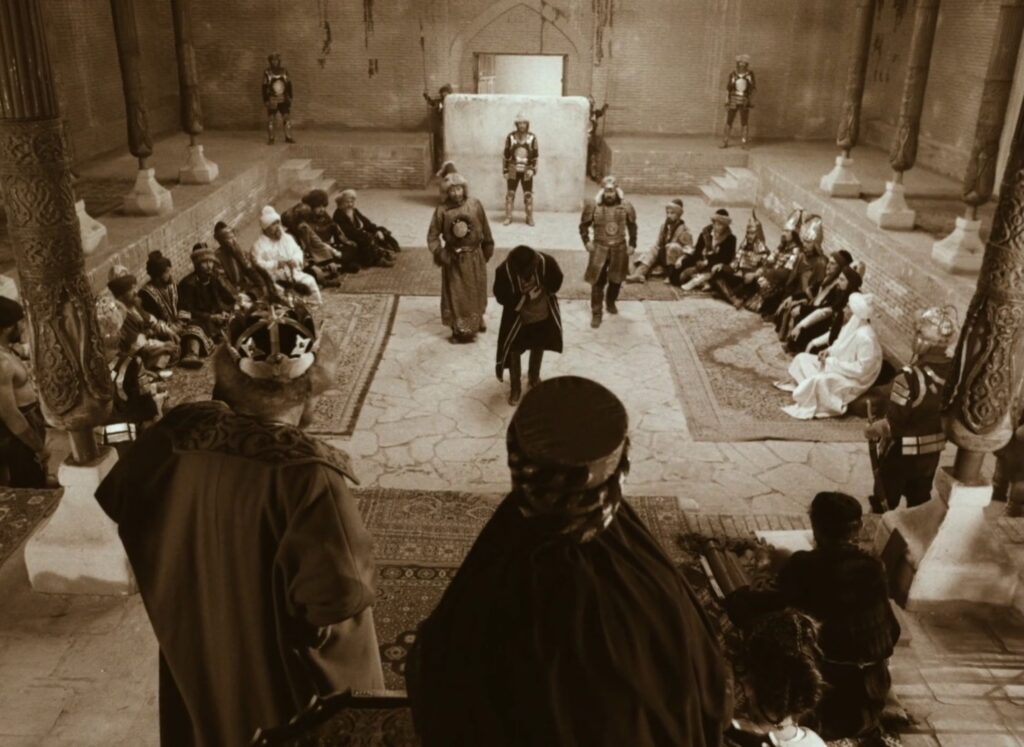
Indeed, Amirkulov proves masterful in capturing the rugged majesty of Kazakhstan’s vast grasslands and mountain ranges, yet still his camera remains drawn to the earthy details that drag this legend back into dirt, dust, and sweat. Not even lavish Persian rugs can conceal the grime clinging to cramped tents and mud-plastered corridors, each swallowed by deep, oppressive shadows and confined through claustrophobic framing. When snow begins to fall, Amirkulov uses the winter landscapes to stretch massive armies across bleak, white horizons, while behind the scenes he pushed his cast and crew through freezing conditions. It is no surprise that he halted production to source flies for festering wounds, nor that he rebuilt his painstaking reconstruction of Otrar’s citadel each time severe weather battered the set. Aesthetic authenticity is paramount here, and Amirkulov pursues it with an archaeological devotion.
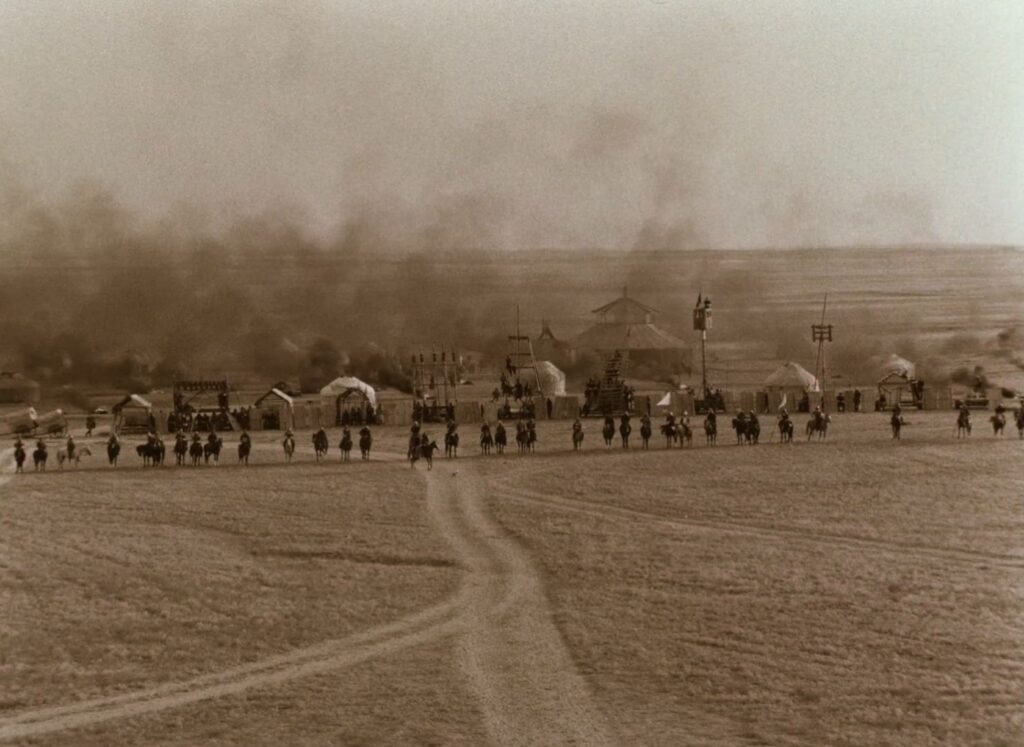

Once we enter Genghis Khan’s endgame, it is notable that we are given our last glimpse of colour, before submitting to a sepia fatalism. The Mongols’ attempt to dig beneath the city walls may have been thwarted, yet by inadvertently toppling Otrar’s mosque tower, they unleash a wave of panic among terrified civilians who believe Allah has turned his back. Sweeping high angles from atop the city walls reveal the advancing army below, and when ladders bring the fight to the battlements, Amirkulov sends his handheld camera into the thick of the action. His epic staging and dynamic editing are clearly indebted to D.W. Griffith, yet medieval warfare has rarely felt so harrowing onscreen.
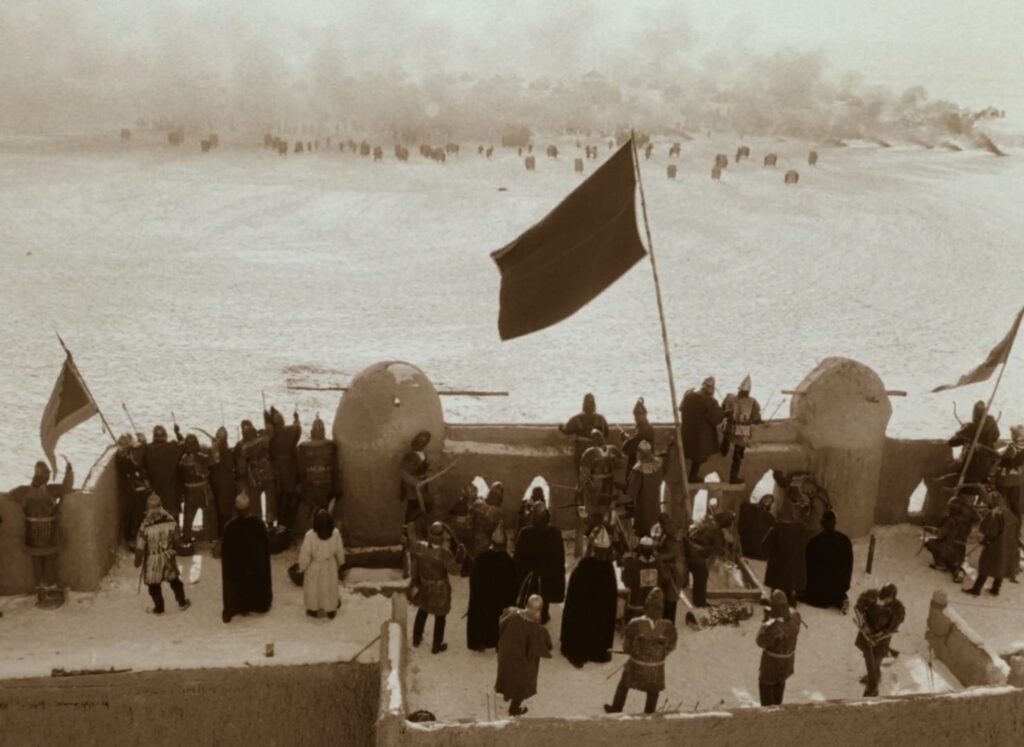
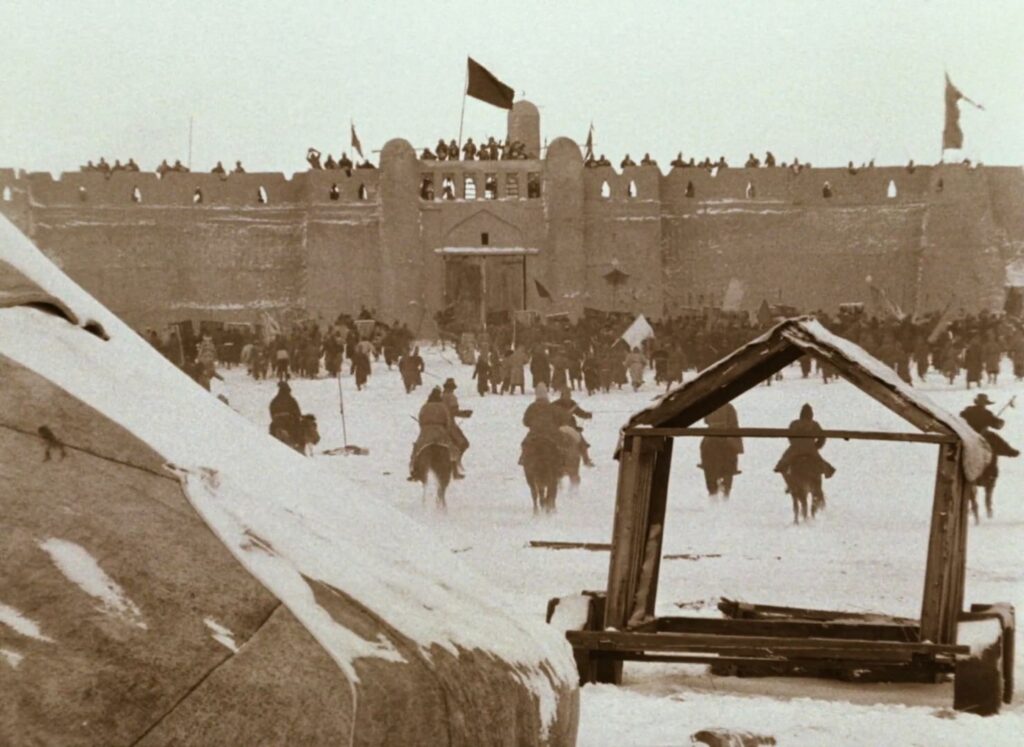
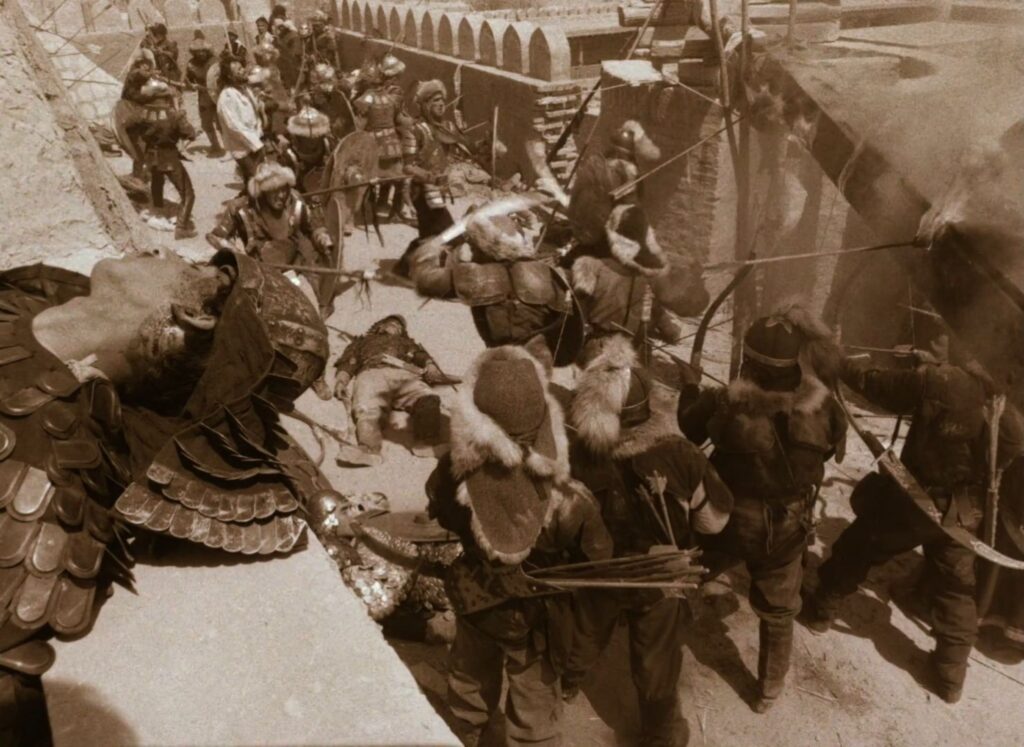
Kairkhan may be a valiant commander, yet with traitors within its walls, Otrar never truly stood a chance against a force that had already conquered countless cities. As his men are cornered, hurled from ramparts, and pierced by arrows, all he can do is tear a strip of silk from his cloak and plug his ears, and Amirkulov’s soundscape responds as its tortured cacophony gives way to a mournful, solitary cello. Even after the battle is lost and Kairkhan is sentenced to death, Amirkulov methodically recreates the ritual of his execution, observing the Mongols prepare the molten silver, pour it over his face, and effectively forge a mask to immortalise his defeat.
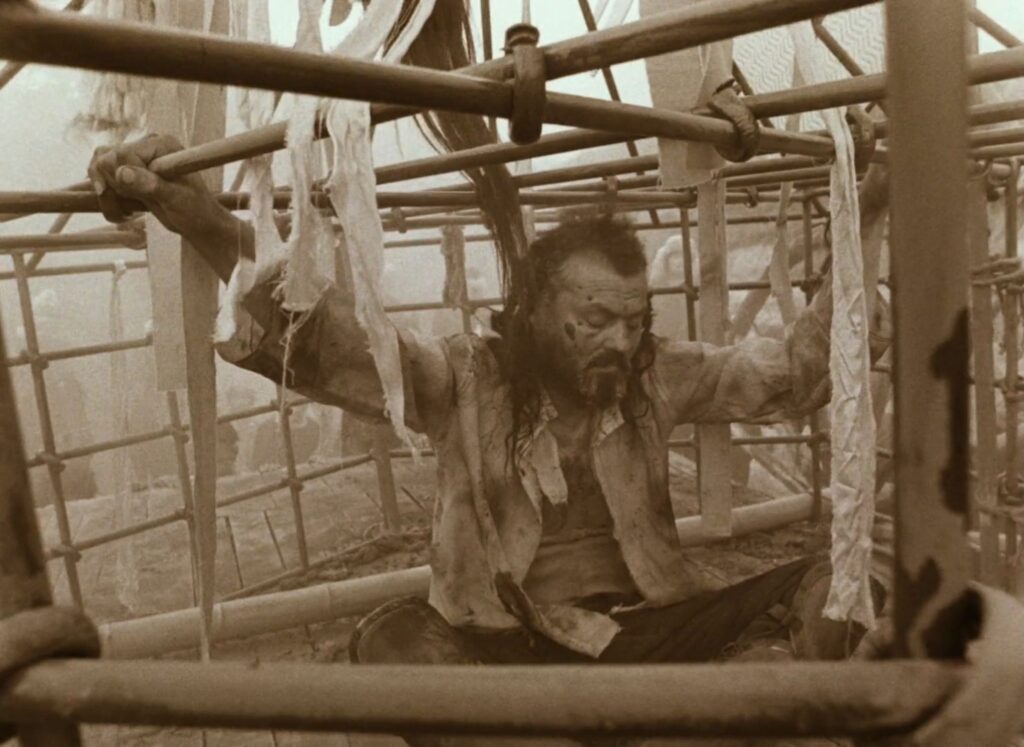
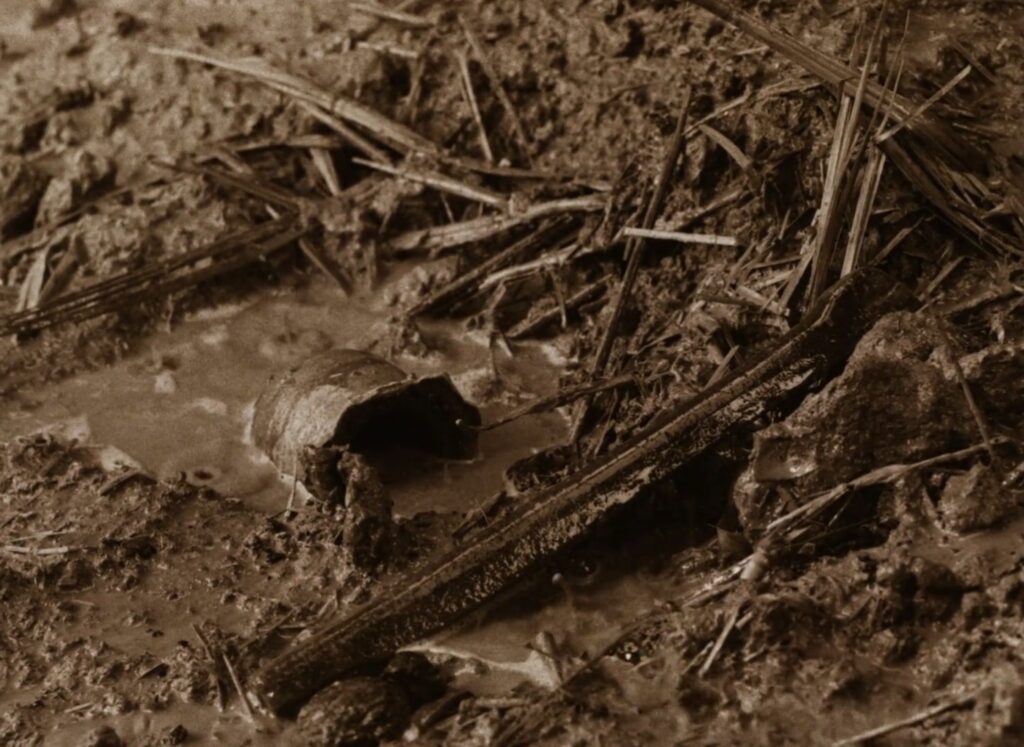
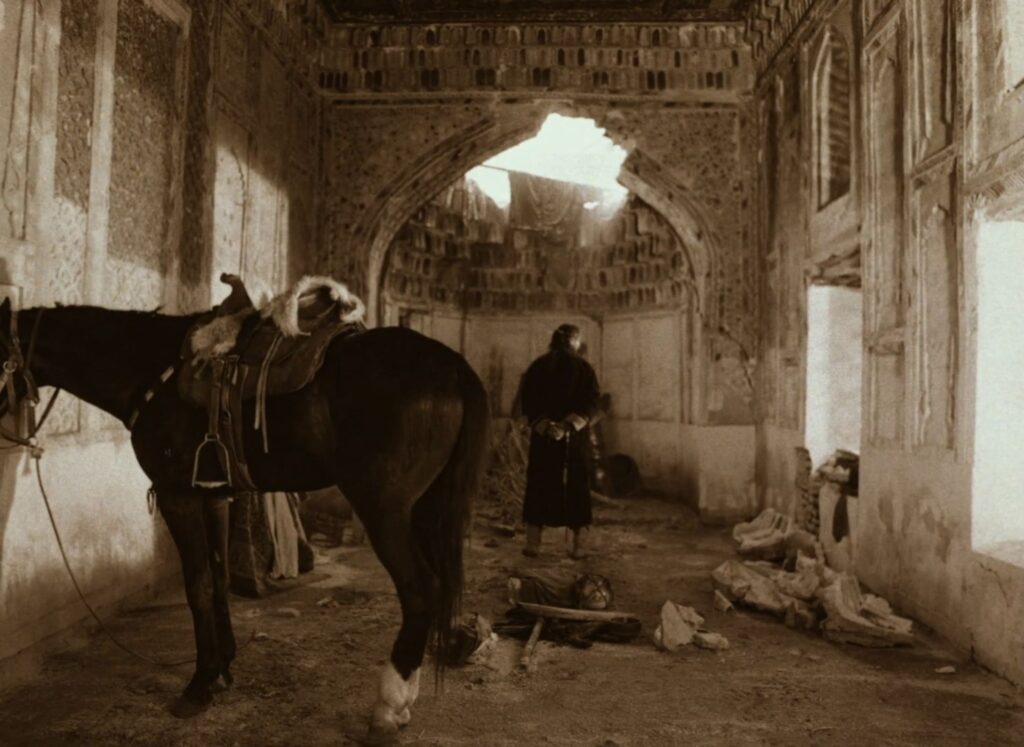
Still, beyond the devastation, Otrar’s story is preserved by the few to survive as witnesses. Rain churns the muddy streets as Amirkulov’s camera drifts over scattered straw, broken pottery, and streams of water, before eventually arriving at a ruined mosque where Unzhu has come to mourn. “Look what has become of my holy city,” his sombre voiceover ruminates. “Who would have thought that the great Kairkhan, who expected me to become a martyr, would end up a martyr himself?” At least Otrar held out longer than any other city, he proudly recounts, though even that is qualified by his own uncertainty – “So I have heard.” Already has this civilisation begun to fade into the blurred edges of memory, and as The Fall of Otrar washes away its physical remnants, we too inherit the burden of remembering its tragic, buried history.
The Fall of Otrar is currently streaming on The Criterion Channel.
Have a film you’d like me to write about next? Request a review here.
Hey Declan, its R_K007, sadly im muted by discord lol, but happy you enjoyed this film, it captures brutality in such an immensely grand and haunting fashion, isnt the film far longer than 1hr 37 mins tho?
Thanks @R_K007, yep that’s a typo on my end – I wrote a 1 instead of a 2. Thanks for the suggestion, such an underseen film but glad it received a restoration recently. Hopefully more people will watch it now.