Javier Calvo and Javier Ambrossi | 2hr 35min

In 1936, shortly after Spanish writer Federico García Lorca penned the first five pages of the unfinished novel La Bola Negra, his life was cut short by the far-right Nationalist faction in the Spanish Civil War. Had he finished the manuscript, it would have been his most ambitious artistic statement yet, and his first to feature an openly homosexual protagonist. Although Lorca is pivotal to Javier Calvo and Javier Ambrossi’s historical film of the same name, it is neither a straight adaptation nor a biopic – after all, Lorca’s presence is scarce, appearing in only a few black-and-white flashbacks recalled by an old friend. Instead, it is the manuscript’s legacy which anchors La Bola Negra’s ambition, poignantly intertwining three tales of queer survival across Spain’s turbulent past and present.
To immediately identify the common thread linking these narratives though would be to undermine the intrigue of their gradual convergence, and Calvo and Ambrossi demonstrate extraordinary patience in establishing each story’s distinct world. The earliest are set respectively in 1932 and 1936, yet given their split between high-society Granada and the frontlines of the Spanish Civil War, they might as well be worlds apart. Carlos is our protagonist in the first, seeking to uphold his wealthy family’s honour by applying to an elite social club called the ‘Casino’, while in the latter Sebastián escapes the bombing of his village and winds up enlisted in the Nationalist army. Leaping ahead several decades to 2017, young academic Alberto is introduced in a far more socially liberal Europe than either of his predecessors, learning that his estranged grandfather has passed away and left him the unexpected beneficiary of his will. Through little more than deft parallel editing and the shared homosexuality of each protagonist, these seemingly disparate tales gradually entwine, weaving an epic, intergenerational triptych of erasure and remembrance.
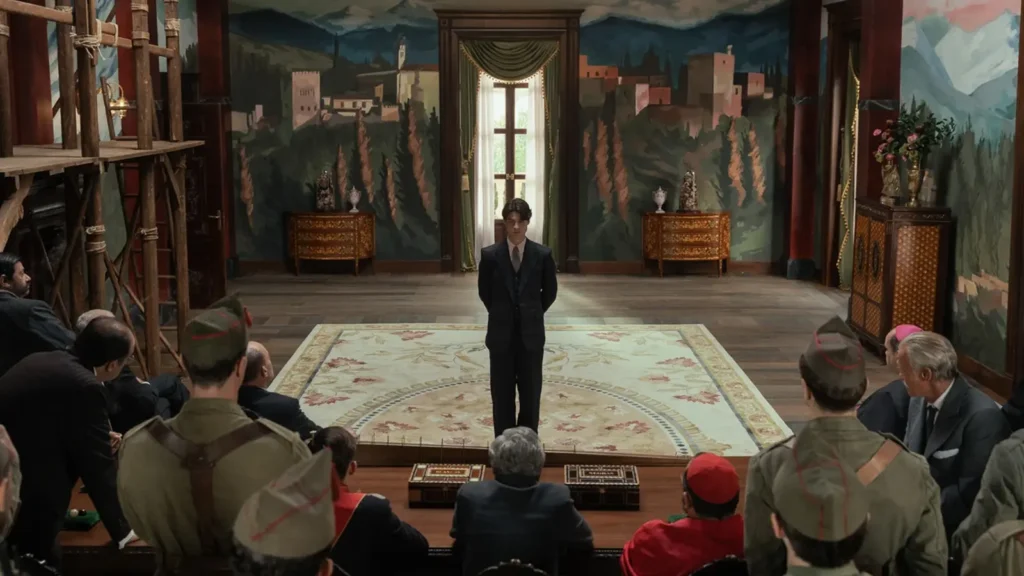
As the least developed of the three, Carlos’ storyline in 1932 gets the short shrift here, though certainly not without purpose. The black balls used by the Casino committee to vote on new members give the film its title, representing an institutionalised system of exclusion, and the politicians and clergymen who cast them make no effort to disguise their prejudice. Carlos’ homosexuality is an open secret in town, denied by his conservative father while accepted among his left-wing peers, leaving him caught between honour and liberation. The Casino’s members consider themselves far above the rabble, yet the historic unrest following General José Sanjurjo’s failed coup nevertheless threatens to upend their social order, turning public anger towards such institutions of wealth and privilege.
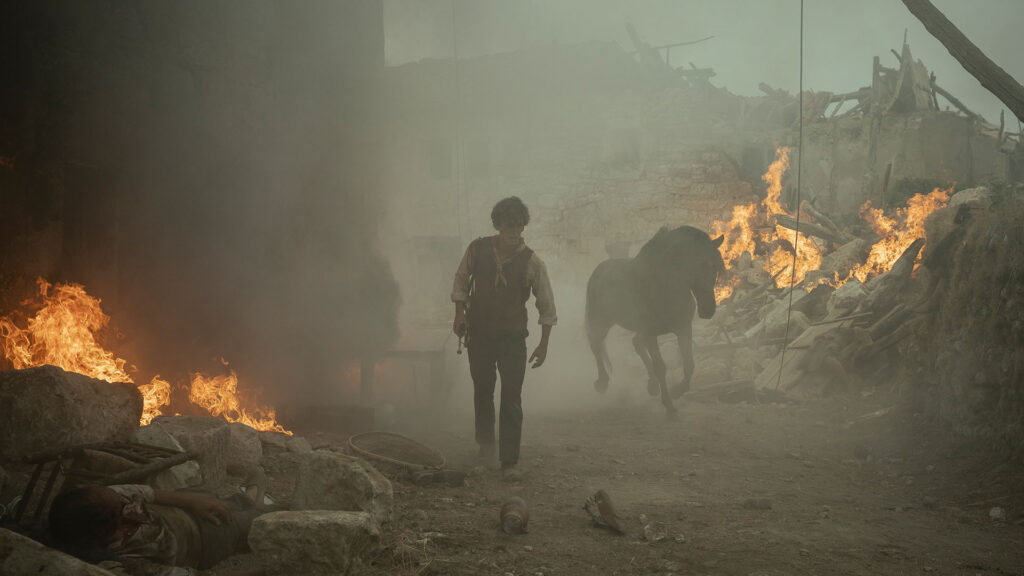
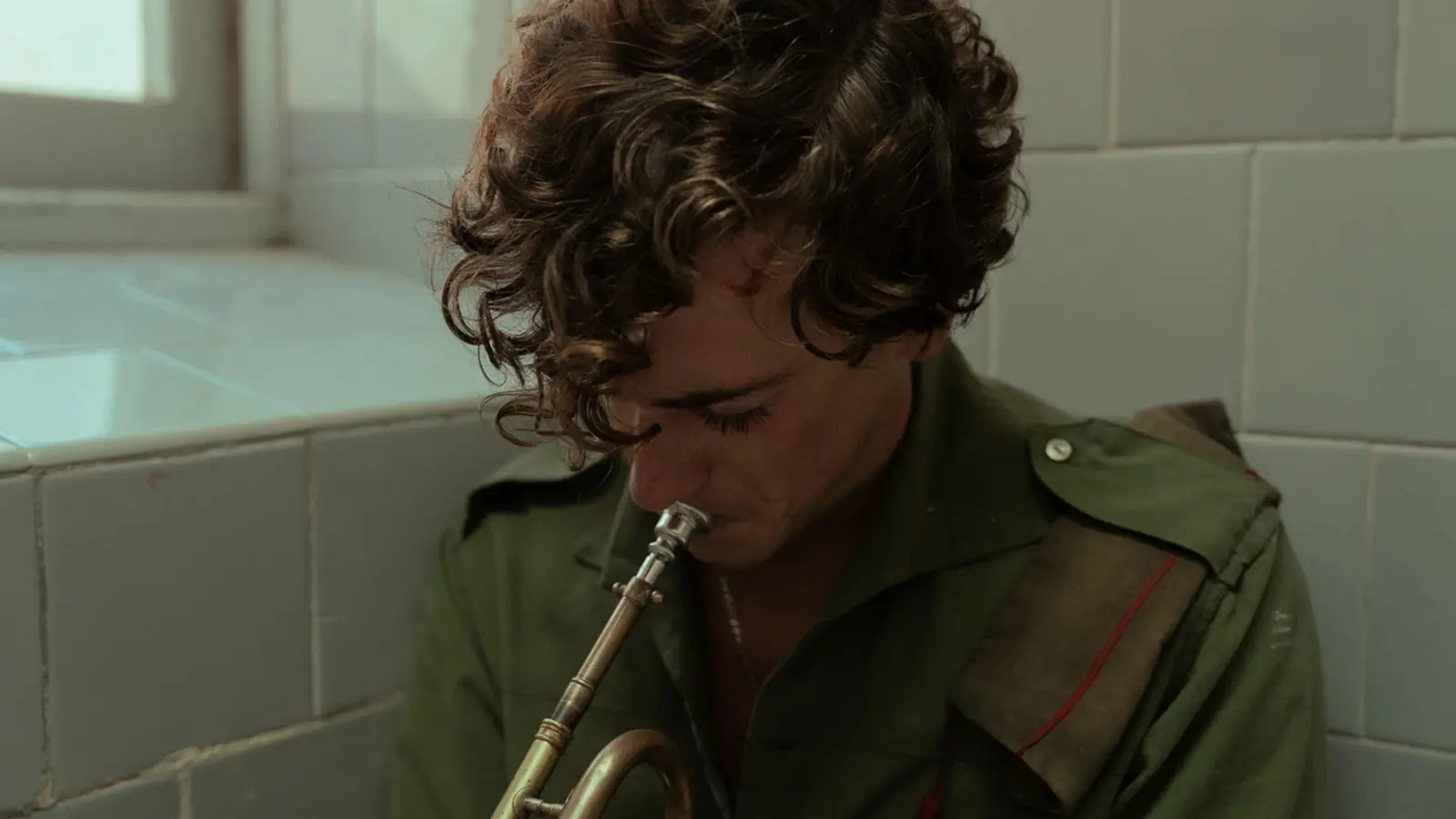
In the 1936 timeline, it is no coincidence that the protagonist should be named Sebastián, particularly given the religious tableau which frames him climbing a shattered statue of Saint Sebastian while his town is bombed. Just as the Christian martyr’s image has been reclaimed as a queer icon for its fusion of youthful beauty and suffering, Sebastián too becomes a figure of hopeful resilience in a hostile world, stumbling through the wilderness with nothing but his trumpet slung over his back. Rescued by the Nationalist military and conscripted into their armed ranks, he is tasked with guarding captured enemy soldier Rafael, yet soon discovers a deeper connection in their emotional isolation. Where the two other tales of La Bola Negra are defined by repression and self-discovery, the doomed romance between Sebastián and Rafael occupies a tragic middle ground, finding tenderness amid the violent divisions of war.

Meanwhile, Alberto’s introduction via a smash cut to a Grindr notification immediately sets the 2017 timeline apart from the other two, exchanging the persecution of the past for today’s casual freedoms. He is at once sexually uninhibited and deeply cerebral, researching buried records of queer artists across early twentieth-century Europe, before turning his attention to their legacy within his own family. Though he has never met his grandfather, his decades-long absence has surely left an impression on Alberto’s embittered mother, who dismissively claims her father would have hated his gay grandson. As Alberto follows a trail of clues left in his will though, a far more vivid portrait begins to emerge of a man who carried immense guilt, pride, and a burdensome responsibility – to preserve a piece of queer history that might disrupt generational cycles of self-denial.
Such creative expressions of gender and sexuality are not exactly contemporary developments after all, and La Bola Negra pays heartfelt tribute to those underground communities of artists who ensured such stories survived humanity’s darkest chapters. Penélope Cruz’ cameo as cabaret performer Nené is fleeting in Sebastián’s storyline, yet she leaves a profound impact after inviting him backstage, recognising in him a hidden kinship and revealing a world of theatrical transgression where men can inhabit femininity without shame. “Transvestism is the fantasy of possibility,” she remarks, while “war is the opposite” – and through this poetic antithesis, Calvo and Ambrossi evocatively frame each act of self-expression in La Bola Negra as an implicit protest against fascist intolerance.

There is no doubt though that Calvo and Ambrossi’s most noteworthy achievement here is their formal orchestration of each narrative thread, assembling a tapestry of collective memory that transcends the limits of any one story. The editing is marvellous, calling back to the structural ingenuity of Mishima: A Life in Four Chapters and The Hours, both of which similarly layer fictional works within the artistic legacies that surround them. As La Bola Negra fluidly intercuts the Casino’s vote on Carlos’ membership with one of Alberto’s casual hookups, it especially illustrates society’s uneasy progress across generations, while dialogue frequently echoes through decades as voiceover to reveal universal desires and struggles.
In encompassing such a vast expanse of time, La Bola Negra’s eclectic score similarly traverses eras and styles, even if its range of Spanish folk music, operatic choruses, avant-garde orchestras, and electronic textures isn’t always as cohesive as the film’s narrative construction. Still, Calvo and Ambrossi achieve an impressive synthesis of non-linear threads here, with artefacts central to Alberto’s investigation gradually emerging as fragments of Carlos and Sebastián’s lives. A surreal, melancholy resolution to one specific storyline particularly expands the film’s boundaries beyond mere archival record, embracing a poetic imagination pushed to the margins of society, yet which nevertheless resonates powerfully through history. More than simply a community, it takes a relay of hands across generations to rescue those radical voices and stories lost to time, casting La Bola Negra’s epic, soulful elegy as the very act of reclamation it honours.
La Bola Negra is now playing in theatres.