
Satyajit Ray | 2hr 20min

The partition of Bengal set off a wave of nationalist fervour in early 20th century India, galvanising the protectionist Swadeshi movement, though it instigates a far more personal crisis for wealthy housewife Bimala. Revolution leader Sandip may be close friends with her husband Nikhilesh, yet they couldn’t be more different, wrenching Bimala’s heart between an icon of fiery passion and a man of calm integrity. Satyajit Ray draws this piercing duality all through The Home and the World, and wielding his romantic epic with a sharp political edge, he stages the battle for Bengal’s soul within the confines of domestic intimacy.
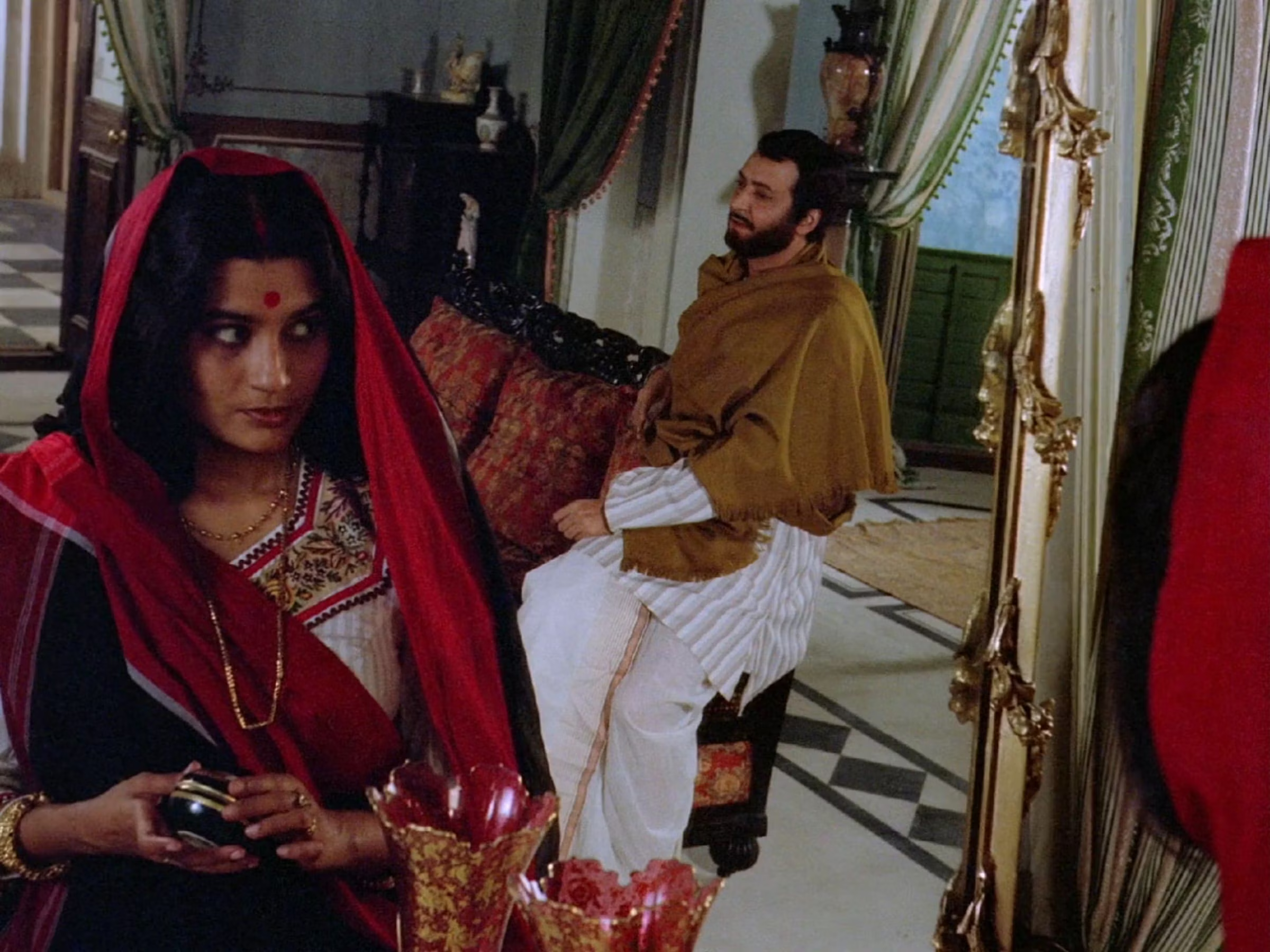
Perhaps most surprising of all though is Ray’s career shift towards opulent melodrama, shedding the realism of his early films for saturated colours and ornate compositions reminiscent of Douglas Sirk. It is a remarkably seamless transition too, heightening Bimala’s awakening with lighting that burns a warm, sunset orange in her home, and slow-motion photography that builds towards her first meeting with Sandip. Thanks to her marriage to the noble Nikhilseh, she lives in a world of affluent privilege, and Ray pours extraordinary detail into his gorgeously curated sets of embroidered textiles, painted wall panels, and floral arrangements. It is easy to be swept away by the sheer emotional vibrance of his period setting, and as such, The Home and the World renders the clash between idealism and desire as both a national and profoundly private battle.


Drawing from Rabindranath Tagore’s 1916 novel, Ray roots this narrative in the British occupation of India, making it apparent from the outset just how much Nikhilesh has assimilated colonial modernity into his household. Having received a western education and welcomed music teacher Miss Gilby into their home to teach his wife English songs, he no longer sees much point in adhering to tradition, particularly if done so blindly. The money he donates to the Swadeshi movement is largely out of loyalty to his friend, though he still finds common ground in their principled opposition to the Governor General, whose move to divide Bengal has driven a wedge between Hindus and Muslims.


When Bimala begins demonstrating a growing political curiosity in the Swadeshi cause, Nikhilesh does not seek to quash her newfound her interest. Quite the opposite, in fact, as he takes her to a rally where Sandip speaks with vehement conviction. “Hail Motherland!” he cries, framed by a cluster of grand pillars in stately symmetry, while Bimala’s awestruck gaze narrows in through a camera zoom. Later when proper introductions are made, he is just as eager to make her acquaintance, expressing delight to welcome a woman into their ranks. From here, the spark between these kindred spirits ignites, leading Bimala to fan the embers of guilty desire in spite of her husband’s warning.


“The less one knows Sandip, the better one likes him,” Nikhilesh cautions one night as they lay in bed, basking in Ray’s deep blue day-for-night lighting. Winding its way around the furniture in their room, his camera gracefully floats toward the gauze drapes which obscure their figures, as if allured by their reflections on this paradoxical friendship. “We both decided to reject the irrational conventions of our society,” Nikhilesh reflects, yet shared defiance is not enough to keep them on good terms forever.

Where Swadeshi is a weapon of coercion for Sandip, pressuring traders to abandon imported goods, Nikhilesh envisions it as an ethical ideal that may only work through voluntary, inclusive participation. His disillusionment deepens as Sindap escalates his schemes, ranging from burning peasant barns to sinking merchant boats, and it takes no great foresight to see how the poor will bear the brunt of such drastic economic upheaval. That many of those impacted labourers also happen to be Muslim only drives the wedge deeper between these religions, ironically reinforcing the colonial divisions carved by the partition of Bengal, and distancing Nikhilesh from the nationalist movement he once hoped could heal these fractures. When these men finally confront each other, Ray’s contrasting colour palettes delicately separate them too, bathing Sindap and Bimala in the lounge’s dim, yellow glow while Nikhilesh stands isolated against the deep green hallway just outside.


Despite her keen intelligence, Bimala is not so quick to catch onto Sandip’s corrosive ambition. She is blinded by infatuation, and just as Ray had previously examined the intoxicating pull of forbidden desire in Charulata, here he extends that inquiry to the seductive power of zealous, charismatic ideology. The Home and the World lightly weaves through her internal voiceover as she ponders these conflicted feelings, while his visual emphasis on mirrors pulls her further away from reality, instead drifting into a world of impressionistic illusion. When Bimala and Sandip finally kiss, the camera swings around them in a swooning arc too – though given that he just coaxed her into donating 5000 rupees, the moment does not quite sit right. She is the Queen Bee of this revolution, he proclaims, effectively exploiting her idealism to bankroll his crusade.

With all this said, Soumitra Chatterjee does not play Sandip as some cartoonish charlatan. His passion is very real, if a little misguided, and he does not hide his vulnerability from his most loyal followers. Bimala’s faith in this revolutionist only shatters when she learns of his plans to partially divert her substantial donation into personal indulgences, though by this point, the social upheaval his rhetoric has unleashed is already taking on a life of its own. Fires beautifully light the night sky as Muslim rioters burn Hindu temples to the ground, silhouetted against the infernal orange blaze, while Sandip makes a swift escape from their wrath. It takes a far braver, nobler man to attempt mediation between these communities, and so after offering his wife the forgiveness she desperately seeks, Nikhilesh sets out to quell the violence.


Words cannot express the grief that engulfs Bimala the following morning when her husband’s body is returned, so dispensing with dialogue altogether, Ray’s devastating final shot carries the heavy tragedy on its own. From a second-storey window, the camera peers out at a funeral procession below, before slowly panning inward to Bimala. As a dissolve shifts us forward in time, her despondent expression remains fixed, yet her attire changes – in place of a green sari, she now wears the traditional white shawl of a widow, mirroring the sombre mourning of her sister-in-law. Even the noblest intentions come at great cost in The Home and the World, though only Bimala’s naïve devotion and Sandip’s exploitation of it can be blamed for the ruin of this household, sealing Ray’s operatic indictment of ideology divorced from empathy, conscience, and responsibility.


The Home and the World (Ghare Baire) is currently streaming on The Criterion Channel.